Pan Mythology: The History and Secrets of the Nature God
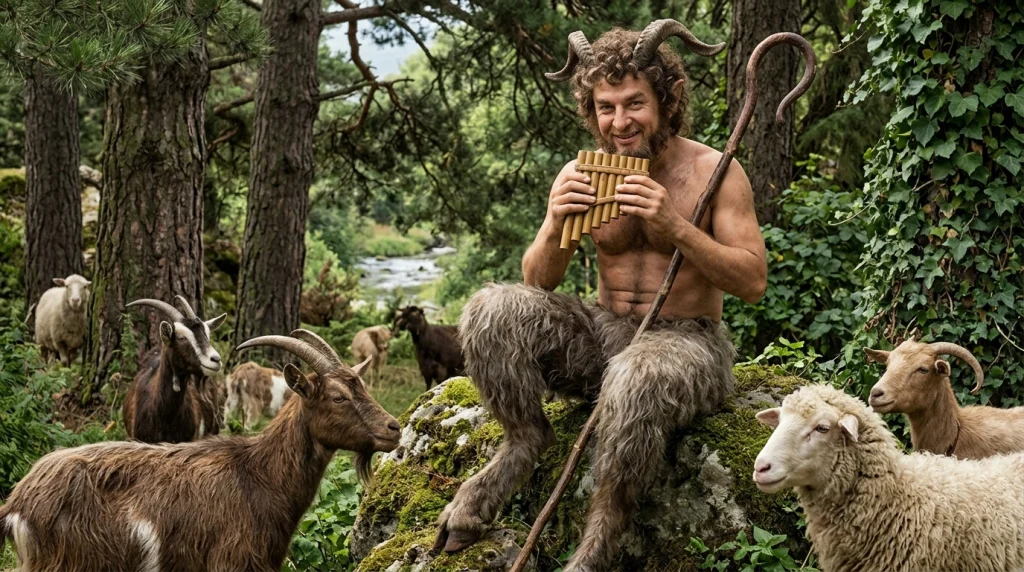
Pan mythology refers to the Greek god of the wild, shepherds, and rustic music, standing as one of the most eccentric figures in the ancient pantheon. He is widely recognized for his powers to inspire “panic” with his voice, his mastery of the pan flute (syrinx), and his hybrid appearance featuring the legs and horns of a goat. In the divine family tree, Pan is most commonly considered the son of Hermes and the nymph Dryope (though versions vary), and he is the father of several forest spirits known as Panes and the wise Silenus.
The Origins and Appearance of Pan Mythology
Unlike the flawless and sculpted Olympian gods, Pan was always seen as an outsider. Legend says that upon his birth, his appearance was so peculiar that his own mother was terrified and fled. However, his father, Hermes, was delighted. He wrapped the infant in hare skins and brought him to Mount Olympus, where all the gods were entertained by his presence. This is why his name is often associated with the word for “All”—because he brought joy to all the immortals.
He does not dwell in marble palaces. The natural habitat of Pan is the rugged mountains of Arcadia, where he leads nymphs in wild dances. This connection to the untamed side of the world is what makes the study of pan mythology so fascinating for those seeking to understand the balance between civilization and natural instincts.
The God of Shepherds and the Pan Flute
As the primary God of Shepherds, Pan is the protector of flocks and hunters. His presence was deeply felt during the silence of high noon in the forests. Ancient shepherds avoided making loud noises at this time, fearing they might wake the god from his nap, which could result in a terrifying encounter.
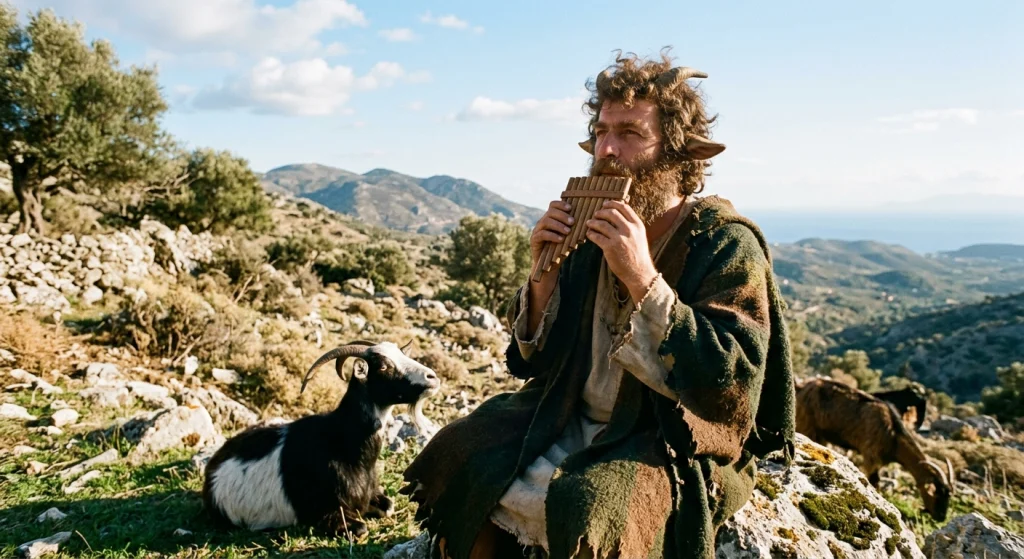
The famous “Pan Flute” has a melancholic origin. Pan pursued a nymph named Syrinx, who, to escape him, begged the river deities for help and was transformed into hollow reeds. As Pan sighed through the reeds, he heard a hauntingly beautiful sound. He cut the reeds into different lengths and bound them together, creating the instrument that became his trademark. This story shows that in mythology, art is often born from unrequited desire.
The Powers and Fear in Pan Mythology
One of the most interesting powers of this deity is his ability to cause “panic.” The very word panic is derived from his name. It is said that during battles, Pan could emit a shout so bone-chilling that it caused entire armies to flee for no apparent reason.
He does not rely on swords or shields. His power resides in the mind and the environment. He controls the most basic instincts of human beings. When you are in a dark forest and feel a sudden, irrational fear, the Greeks would say that Pan is nearby. Beyond this psychological power, he possesses incredible physical endurance and the gift of prophecy; it was actually Pan who taught the god Apollo the art of foretelling the future.
The Lineage and Children of the God of Shepherds
While Pan never officially married like Zeus or Hera, he had many relationships and descendants. His most well-known children are the Panes, smaller deities who inherited his goat-like features and lived scattered throughout the mountains.
Another famous son attributed to him is Silenus, who became the tutor of Dionysus. Silenus inherited his father’s love for music and celebration, but also the hidden wisdom that comes from the wild. In pan mythology, the god’s offspring serve to spread the energy of the wilderness across the Greek world, ensuring that forests and fields never lose their untamed essence.
Pan Mythology and the Encounters with Nymphs
Pan’s daily life is marked by his constant pursuit of nymphs. He is a god of voracious appetites and inexhaustible energy. However, many of his stories end with nymphs fleeing or transforming to avoid his advances, as happened with Echo and Pitys.
Echo was a nymph with a marvelous voice who rejected Pan. In some versions of the myth, Pan’s fury was so great that he drove local shepherds into a frenzy, causing them to tear her apart until only her voice remained to repeat what others said. These tales serve as a warning about the dangerous and unpredictable side of the God of Shepherds, who can shift from extreme joy to cruel vengeance in an instant.
The Symbolism of the God of Shepherds in Culture
For ancient philosophers, Pan represented the sum of all nature (using the “pan” prefix in Greek). He was the bridge between the animal and human kingdoms. While his human head and torso represent reason and speech, his goat legs and horns represent basic survival and primal impulses.
In the modern era, Pan has been reclaimed by various artistic movements. He is seen as a symbol of freedom against the rigid rules of urban society. He invites us to observe the beauty of the wild and the uncontrolled. Without the figure of Pan, the mythological world would be a purely mechanical place, lacking the spontaneous enthusiasm that nature provides.
The god Pan is portrayed as a figure of some importance in the Percy Jackson series. His storyline is linked to Grover, the protagonist’s friend. If you are curious about the series’ universe, visit the percy jackson cabin quiz to find out which cabin you would belong to at Camp Half-Blood.
The Death of Pan and the End of the Ancient Era
One of the most enigmatic reports in classical history is “The Death of Great Pan.” During the reign of Tiberius, a sailor heard a voice calling out from the Greek islands: “The Great Pan is dead!” This is the only recorded instance of a Greek god’s death being publicly announced.
Historians debate this event to this day. For many, the death of Pan symbolizes the end of the era of natural myths and the transition to a new religious period. However, for scholars of pan mythology, the god remains alive in cultural memory and literary representations. He survives as a reminder that nature, though sometimes silent, has a voice of its own that can never be fully forgotten.
Sacred Sites and Facts About the God of Shepherds
Unlike the massive temples of Athens, the sacred sites dedicated to Pan were usually natural grottos and caves. The Grotto of Pan on the slope of the Acropolis is one of the most famous examples, where Athenians paid tribute to thank the god for his help during the Battle of Marathon.
The God of Shepherds was honored with simple offerings such as honey, milk, and aromatic herbs. These practices demonstrate that his connection with the people was direct and lacked the bureaucracy of large state rituals. Pan was the god of simplicity, of flute music at dusk, and of the protection of those who lived by the land and for the land.
If you’re interested in animals and their personalities, I recommend the following quiz:
For more information on this topic: