Beasts and Creatures: The Role of Animals in Greek Mythology
Greek mythology is one of the richest pillars of Western narrative. When we think of the myths of Ancient Greece, our minds are usually flooded with images of imposing gods atop Mount Olympus or courageous heroes facing tragic destinies. However, woven tightly between these stories is an equally vital and fascinating element: mystical animals and creatures.
Far from being mere background extras or disposable obstacles, animals in Greek mythology functioned as extensions of divine will, symbols of untamable forces of nature, and psychological and physical tests for a hero’s evolution. Setting aside popular figures like the Centaur, the Three-Headed Dog (Cerberus), the Sphinx, and the Hippogriff, we discover a vast mythological ecosystem inhabited by beings ranging from winged horses to horned serpents.
1. Pegasus: The Symbol of Celestial Aspiration
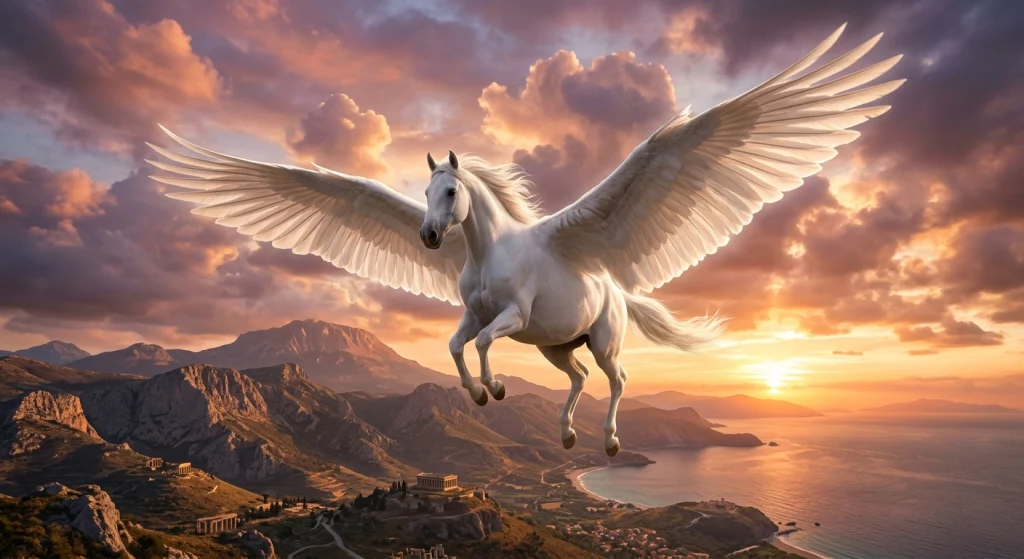
No animal captures the mythological imagination as purely as Pegasus, the winged horse. Born from a violent event—springing from the neck of Medusa when she was decapitated by the hero Perseus—Pegasus represents the transcendence from the monstrous to the divine. His pure white coat and immense wings connected him directly to the realm of the heavens.
Pegasus was not an animal that could be domesticated by ordinary means. It was the hero Bellerophon who, with the help of a golden bridle gifted by the goddess Athena, managed to tame the creature. Together, they achieved great deeds, including the destruction of the Chimera.
However, the story of Pegasus also serves as a stark warning about hubris (human arrogance). Fascinated by his own success, Bellerophon attempted to fly Pegasus to the very summit of Mount Olympus to join the gods. Zeus, angered by the mortal’s audacity, sent a gadfly to sting the winged horse. Pegasus reared, throwing Bellerophon back to Earth, while the animal continued his flight to Olympus, where he was tasked with carrying Zeus’s lightning bolts. The winged horse teaches us that while the divine can be a temporary ally to man, it ultimately belongs strictly to the heavens.
2. The Erymanthian Boar: The Brute Force of Nature
While Pegasus represents weightlessness and spiritual elevation, the Erymanthian Boar symbolizes the exact opposite: the weight, ferocity, and chaos of untamed, undomesticated nature. This gigantic creature inhabited the mountain of Erymanthus, a region in Arcadia, and terrorized local villages, destroying crops and killing anyone who crossed its path.
The capture of the Erymanthian Boar was the fourth labor of Hercules (or Heracles). Unlike other missions where the hero was required to slay the monster, King Eurystheus demanded that the boar be brought back alive. This required not just brute strength from Hercules, but clever strategy.
Hercules pursued the animal for days through dense forests, gradually exhausting it. His masterstroke was driving the beast toward a ravine covered in deep, heavy snow. The boar’s massive weight caused it to sink and become trapped, allowing Hercules to bind it with chains and carry it on his shoulders back to the palace. Legend has it that King Eurystheus was so terrified upon seeing the live animal that he hid inside a bronze pithos (a large storage jar). The boar represents winter and the devastating seasonal forces that ancient man had to learn to contain to ensure the survival of civilization.
3. The Stymphalian Birds: Hidden Danger and Pestilence
Further into the catalog of Hercules’ trials, we find the Stymphalian Birds, the protagonists of his sixth labor. Inhabiting the dense marshes around Lake Stymphalia in Arcadia, these birds were far from ordinary. They possessed beaks, wings, and claws made of bronze, and their feathers could be launched like deadly arrows at their prey. Furthermore, their droppings were highly toxic, poisoning the region’s crops and water, serving as a mythical representation of plague and rot.
The great challenge for Hercules was both their sheer number and their location: the birds hid deep within the marsh’s dense vegetation, making it impossible to fight them directly or reach them on foot. To solve this dilemma, the goddess Athena intervened once more, providing the hero with a pair of krotala (bronze clappers or noisemakers) forged by Hephaestus, the blacksmith god.
By climbing a nearby hill and shaking the instruments, Hercules generated a sound so deafening and shrill that the birds panicked and took flight en masse. In the open sky, they lost the protection of the swamp, allowing the hero to shoot down a vast number of them with his arrows dipped in the poisonous blood of the Hydra of Lerna, while the remainder fled never to return. This myth illustrates how intellect and the right tools (the technology of the era) are fundamental to dispelling hidden threats and evils that seem intangible.
4. The Cerastes: The Slithering Cunning of the Deserts
Moving away from grand heroic labors and exploring the Greek bestiary focused more on mythological natural history described by ancient poets and scholars, we encounter the Cerastes. Described extensively in antiquity by authors such as Herodotus and Pliny the Elder, the Cerastes was a highly flexible mythical serpent, notable for having no bones in its spine and featuring two or four small horns on its head, similar to those of a ram.
The hunting strategy of the Cerastes was entirely based on disguise and ambush. It would bury almost its entire body in the desert sand or under dry leaves, leaving only its small horns visible. Small animals and birds, mistaking the horns for food shoots or seeds, would approach innocently. Once the prey was within reach, the serpent would emerge with breathtaking speed to deliver its venomous strike.
In Greek literature and culture, the Cerastes was frequently used as a living metaphor for betrayal and falsehood. It represented the type of enemy who does not confront their victim face-to-face with open strength, but who camouflages themselves within the everyday environment, patiently waiting for the other person’s moment of greatest vulnerability.
Many of these creatures appear in the Percy Jackson series, which portrays much of Greek mythology from the perspective of a young person living in the 21st century. Their appearances shape entire chapters. If you are interested in the Percy Jackson universe, take our Percy Jackson cabin quiz to find out which cabin is yours.
Comparative Table: The Roles of Animals in Myth
To understand how the Greek mind organized these creatures, we can analyze their main characteristics, primary origins, and the cultural symbolism they held for that society.
| Mythological Animal | Distinctive Physical Feature | Primary Origin | Cultural Symbolism |
| Pegasus | Horse with white swan-like wings | Medusa’s blood | Divine aspiration, poetry, and transcendence |
| Erymanthian Boar | Gigantic boar of immense strength | Arcadia region | Natural chaos, winter, and untamed brute force |
| Stymphalian Birds | Bronze feathers, claws, and beaks | Arcadia marshes | Pestilence, invisible danger, and stagnation |
| Cerastes | Boneless serpent with horns | North African deserts | Cunning, betrayal, and hidden danger |
The Divine and Metaphorical Connection – Animals in Greek Mythology
In Ancient Greece, the natural world and the supernatural world were not separated by a rigid line. Animals were viewed as the visual vocabulary of the gods. When Zeus wanted to observe mortals or intervene directly, he frequently took the form of an eagle or a bull. When Artemis wished to punish a city for failing to perform rituals in her honor, she sent a destructive boar (such as the famous Calydonian Boar).
Therefore, when analyzing these creatures, we realize that the Greeks used animal behavior—amplified by fantastic elements like wings or metal parts—to explain human behavior itself and the dynamics of the world around them. The fear of a diseased swamp became the myth of the metallic birds; the fear of the desert and stepping in the wrong place birthed the legend of the Cerastes.
Studying these animals is, at its core, understanding how ancient peoples processed their fears, their ambitions, and their eternal search for order amidst the chaos of the wild world. Through these stories passed down across generations, the zoo of Greek mythology remains alive, populating books, art, and pop culture to this very day.
If you’re interested in animals, play our animal soul quiz. Discover which animals your characteristics match with.
For more information on this topic, visit: https://www.centreofexcellence.com/greek-monsters-creatures/